


Losing weight is usually one of the main goals of training for the fairer sex.It seems that fitness centers are filled with all kinds of exercise - from yoga to swimming, from dancing to the gym.However, choosing the wrong charge from all the variety sometimes does not lead to positive results.Because losing weight is a complex process and requires not only regularity, but also compliance with certain nuances that ensure fat burning and not only strengthen muscles and improve well-being.
What weight loss workouts are there for at home and in the gym and who are they suitable for?
The choice of such training is actually huge.But all of these areas are based on the same principle - aerobic exercise.That is, to ensure fat burning, it is necessary to increase the pulse to a certain range where the process of lipolysis begins.To put it simply, this involves strong, constant loads in non-stop operation.These stresses include not only fitness activities, but also running, cycling and other cardio exercises.Home workouts can also be tailored to the fat burning load.The main thing is to know a few simple rules, which we will talk about a little later.
Aerobics classes
This fitness category includes all types of classic aerobics - step aerobics, aqua aerobics, bosu, fitball and tai-bo.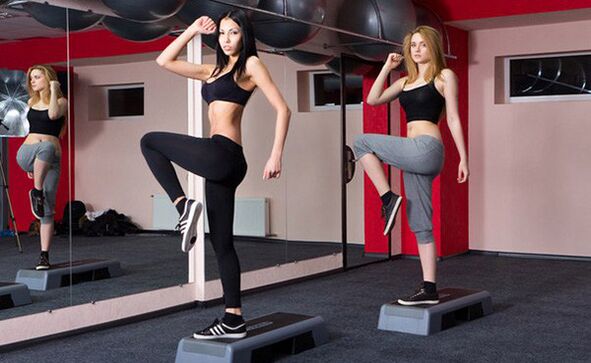 Although the level of stress is quite high, it is sometimes not possible to maintain the pace and repeat the trainer's choreography the first time, so beginners often rest instead of training.However, it is also important to understand that these directions place shock load on the knees and heart muscle.It is worth starting training at a basic level.
Power classes
In contrast to the load on the equipment, here exercises with free weights are performed in the same rhythmic non-stop mode as in aerobics classes.This means that the training pace is quite high, which also requires good health, including of the heart.In areas such as functional training, body pump and super sculpt, the muscles are trained on light fitness equipment and at the same time strength exercises such as squats, lunges, presses and the like are carried out.Such loads are perfect for beginners, but you should start with a light load.
Cardio training
This includes running in the park and cardio exercises.That is, in contrast to fitness classes, the load is carried out on one or more devices for a certain period of time.Not only running on the treadmill or Orbitack allows you to burn fat, but also alternating strength and cardio exercises.Jumping rope and plyometric exercises are also cardio exercises.Workouts such as running or plyometrics are only suitable for people who do not have problems with their joints, spine and heart.However, the advantage of such training lies in the choice of suitable training equipment that does not cause shock and pressure loads, for example an Orbitrek and an exercise bike.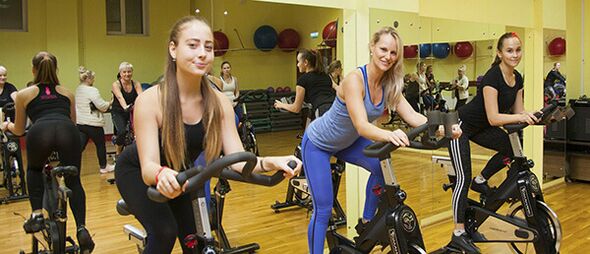 This already enables people with joint problems and older people to train.
Interval training
One of the most effective methods for losing weight.The benefit of losing weight is doing strength training for a period of time and then doing cardio training.Either there is a more intense exercise followed by a less intense one, or you rest.The order and names of the exercises depend on the program and type of training and are subject to change.These workouts include classic interval training, HIIT, the Tabata protocol and some CrossFit complexes.Before starting such training, you should undergo preparatory physical training.Heart or joint problems are also a contraindication to high-intensity training.
Strength training for endurance
Strength training in the gym can also help you lose weight, as long as you choose the right exercise program.Therefore, the emphasis should be not on the weight of the load, but on the number of repetitions.The more repetitions there are, the lower the load.The choice of load weight is chosen so that at least 15 repetitions can be performed.Such training can be either circular - for all muscle groups in one training session - or split training - 2 muscle groups in one session.In any case, the goal of training is to perform as many repetitions as possible, from 15 to 25, with short breaks between sets - 1 or 1.5 minutes.
How to exercise to lose weight
All types of training have one thing in common: the heart rate range during the exercise period is in the range of 50 to 70% of the maximum heart rate.
- If the pulse is below the lower limit of this zone, the body becomes stronger and healthier, but no fat burning occurs.
- The same applies to overcoming the upper threshold, which helps to strengthen the heart or improve speed qualities and, in beginners, on the contrary, leads to excessive stress on the heart.
Therefore, it is important to calculate your heart rate zones before you start losing weight:
- 220 – Age = X
- X multiplied by 0.5 is the lower limit.
- X multiplied by 0.7 is the upper limit.
In this way, determine the upper and lower limits of the fat burning zone.
The frequency of training is also important.You don't need to train every day, an average of 3-4 training sessions per week is enough.We won't go into length about the importance of post-workout recovery.Even if there is no muscle soreness the day after cardio training, the absence of muscle pain does not mean that the training was unproductive and pointless.On the contrary: the heart has received sufficient stress, even if this is not noticeable.Accordingly, rest is necessary between such training sessions.
And another important point– Duration of training.On average, a fat burning workout should last 40 to 60 minutes.This interval is optimal to achieve the goal.However, if you exercise for less than half an hour, the effect will be insignificant.But you shouldn't exceed the duration either.More doesn't mean better.
How to Create a Fat Burning Workout for the Gym and at Home
Option 1: Cardio
If you decide to do monotonous cardio exercises in the form of running in the park or on one of the cardio machines in the gym, it is important to maintain the permissible heart rate zone when performing the exercise.Train for an average of 45-60 minutes.In this case, you can perform the load in interval mode, which is provided in the simulator menu, or alternate running and walking when a more intense load changes to a less intense load.
Option 2: Alternate strength training and cardio
Alternating strength and cardio exercises.The important thing here is not to overload the load and to dose all muscle groups clearly.To do this, you should create a set of 6 basic exercises for all muscle groups and alternate them with cardio exercises.Below is an example.The main thing is to consider which muscle groups are involved in which exercises.For example, there should be no more than 2-3 exercises for the leg muscles and one exercise for smaller muscles.
Option 3: High-rep strength training
Another example of circuit training that consists only of strength exercises.With this option, choose 8-10 exercises for the main muscle groups.The first exercises in the program should target the largest muscles - preferably the legs, then the smaller ones.The complex can consist of both basic exercises - squats, rowing, pressing and isolating exercises, that is, only for one muscle - arm curls, arm extensions, exercises for the deltoid muscles.
The best exercises for losing weight
Using an example, we will consider circuit interval training for the gym, as well as a fat burning complex for home training without equipment.
A set of exercises for losing weight in the gym
Day 1
- Squats in Smith x 15-20.
- Running on the treadmill – 2 minutes.
- Romanian deadlift x 15-20.
- Running on the treadmill – 2 minutes.
- Pull-ups on a low bar x 15-20.
- Running on the treadmill – 2 minutes.
- Push-ups in TRX x 15-20.
- Running on the treadmill – 2 minutes.
- Dumbbell presses x 15-20.
- Running on the treadmill – 2 minutes.
- Bike x 15-20.
- Running on the treadmill – 2 minutes.
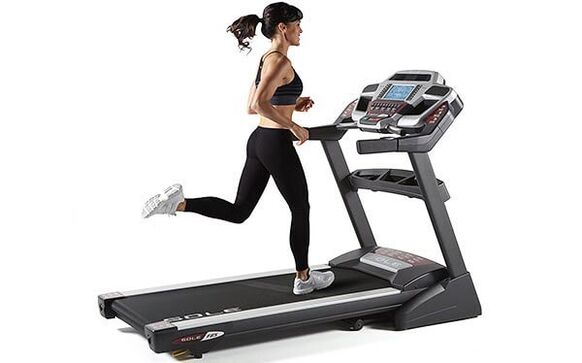
After you complete the first pass, rest for two minutes and then repeat the process two more times.
Remember that every workout should start with a warm-up and end with stretching exercises.
Day 2
- Leg press x 15-20 times.
- Jump rope – 50 times.
- Lunges x 15-20.
- Jump rope – 50 times.
- Block pull to strap x 15-20.
- Jump rope – 50 times.
- Dumbbell bench press x 15-20.
- Jump rope – 50 times.
- Standing dumbbell fly x 15-20.
- Jump rope – 50 times.
- Leg raises x 15-20.
- Jump rope – 50 times.
Make the same 3 circles.
Day 3
- Plie squats x 15-20.
- Burpee x 10 times.
- Hyperextension x 15-20.
- Burpee x 10 times.
- Sweater x 15-20.
- Burpee x 10 times.
- Arm extension with dumbbells behind the head x 15-20.
- Burpee x 10 times.
- Curling arms with dumbbells in supination x 15-20.
- Burpee x 10 times.
- Setups x 15-20.
- Burpee x 10 times.
Repeat the complex three times.
Fat burning workout at home
As an example of home training, consider a complex repeated every other day and performed only three times a week.You can replace exercises according to the example in the recommendations above.If you have sports equipment at home, the complex can be varied and supplemented with other exercises.
Warm up with a jump rope for 5-7 minutes.
- Jump in place 20 times.
- Alternately lunge forward 20 times with each leg.
- Jumpin Jacks x 20 times.
- Planks with forearms x 20 reps.
- Airborne lunges x 20 times.
- Reverse push-ups x 20 times.
- Burpee x 20 times.
- Plank jumps back and forth x 20 times.
After the circuit, rest for 2 minutes.Do three circles, at the end of the workout you can jump rope and stretch your muscles for 5-10 minutes.
What results can you achieve in a week and in a month?
By exercising regularly three times a week, you can achieve excellent results within a month.You should not expect drastic changes in a week, but you may still observe the appearance of muscle tone and a slight decrease in volume.Depending on your metabolic rate and diet, which is important for weight loss, the results will vary.Some only lose 2 kg, others 5 kg.The main thing is to see the result afterwards, because first the volumes disappear, so it is better to monitor the result by measuring body volumes rather than weighing.